
World Trip Diary #1: Istanbul, the Gate of the East
Our journey around the world started in Istanbul, Türkiye on 16 September 2026. We spent 3 full days in the city which felt like fine mixture of West and East.
· by Krisztofer & Dávid · 12 min read
We arrived quite late at Istanbul’s Sabiha Gökçen Airport and headed to our accommodation near Taksim Square.
On our first night, we went for a short walk around Taksim Square. It is a huge, busy place, not particularly beautiful, but a good spot to watch people passing by, locals and visitors alike. İstiklal Street, one of Istanbul’s most famous pedestrian streets, starts here. It is lined with shops, restaurants and historic buildings, and a beloved red tram runs through the middle of it.
The sheer number of people on this street was quite an experience. It was really busy! Around Taksim, you can grab a döner from a kiosk or try the interesting-looking ıslak hamburger, or wet burger. It is literally a burger, but steamed, which makes it super juicy.
We also passed Hafiz Mustafa, one of the city’s best-known sweet shops, famous for its baklava and Turkish delight. There is a takeaway section downstairs and a café upstairs. There was a queue even late in the evening, but the shop is open 24/7. We didn’t try it that night, though. We would find somewhere even more special to satisfy our baklava cravings later in our stay.
Eventually, we ended up at a small restaurant called Dürümce for some dürüm with Adana kebab. We got some çiğ köfte as a complimentary starter, a spicy mixture traditionally made with fine chickpeas and herbs, served with lettuce leaves and lemon. It was a good first taste of Turkish food.
We spent three full days in Istanbul, which honestly wasn’t enough. We weren’t particularly organised and took our time, so a fourth day would have been a good idea. Still, three days can be enough to see many of the main sights if you plan your time well.
Day 1: From Galata to the Historic Peninsula
We started our first full day with simit at Cihangir Tarihi Simit Fırını. This sesame-covered bread ring is sold all over the city and is a simple way to start the morning. Have some Turkish tea with it, and you’re set for the day. Tea is everywhere in Türkiye, and locals seem to drink it at any time of the day.
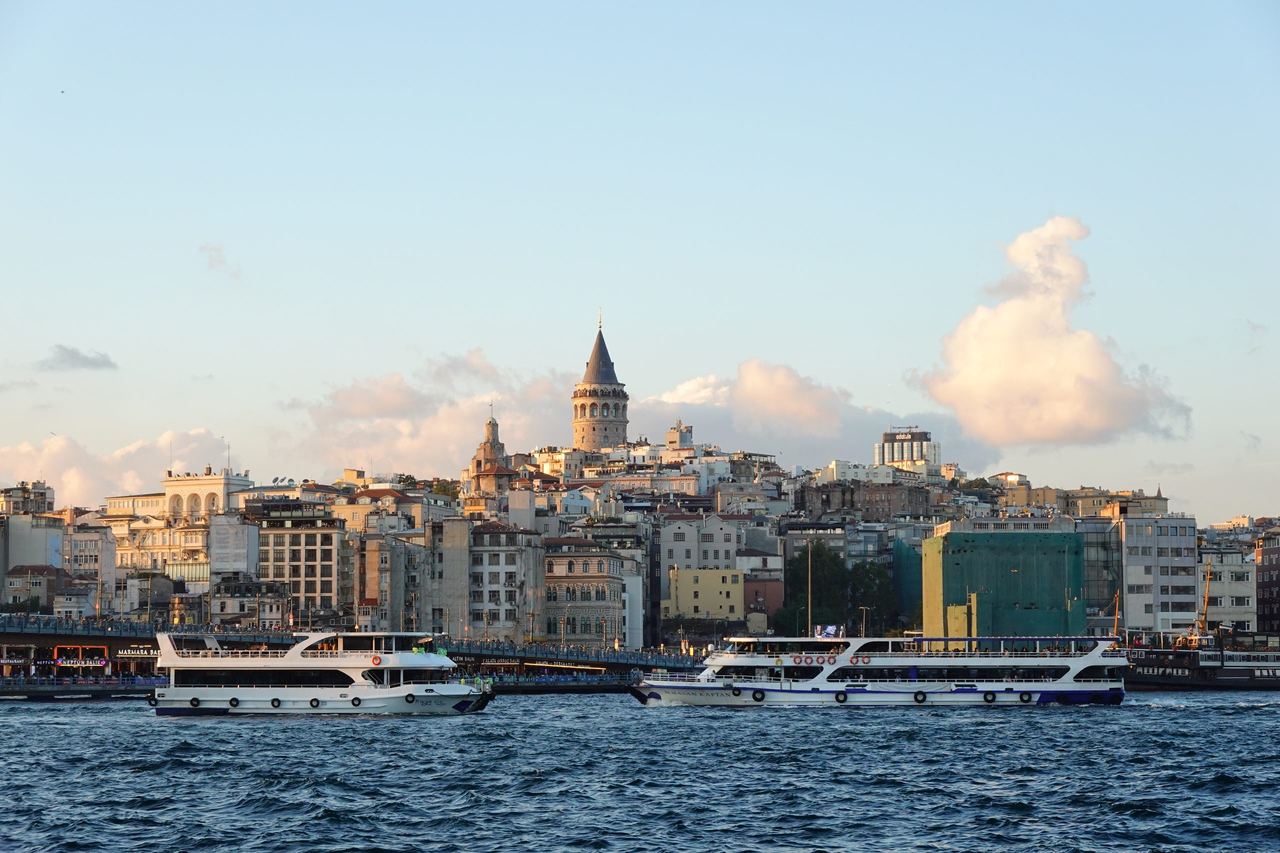
After breakfast, we climbed the steep streets towards İstiklal Street and continued to Galata Tower. Built by the Genoese in 1348, this medieval stone tower has become one of Istanbul’s most recognisable landmarks. It has also become extremely popular in recent years, partly because it looks so photogenic from the surrounding streets. There is a lot of hype around the San Sebastian cheesecake served in many cafés in the area, too. We decided not to climb the tower, as the ticket would have cost us €30.
We continued towards Galata Bridge, passing through a fancier part of the city and by the Kamondo Stairs. The bridge is always full of things to watch. Fishermen and their feline companions look for fish, cars honk — which is true for almost everywhere in Istanbul, actually — and ships and ferries pass through the Golden Horn and the Bosphorus. The bridge connects the historic Eminönü area with Karaköy on the other side of the Golden Horn.
After crossing the bridge, we somehow ended up in a bazaar on our way towards Süleymaniye Mosque. Sitting on a hill overlooking the Golden Horn, the mosque dominates the skyline and offers some iconic views of the city. Built between 1550 and 1557, it is one of the finest examples of classical Ottoman architecture.
The mosque was free to visit, and we found it a very relaxing place after the busy streets. Its gardens offer beautiful views, while the interior is equally impressive. We sat around for a while, taking in the architecture and decoration, when a friendly volunteer approached us and told us a little about the mosque and Islam.
We learned about the importance of calligraphy in Islamic decoration and noticed the large circular panels bearing the many names of Allah. We also discovered that ostrich eggs had traditionally been placed among the decorations of some mosques, partly to help keep insects away. It was a lovely, unexpected encounter that made our visit even more interesting.
After learning a little more about the country’s main religion, we headed to the Grand Bazaar. It was certainly an experience to walk among the crowds of tourists and locals, surrounded by shops selling spices, sweets, tea, jewellery and clothes. However, we also found it overwhelming. The sellers were very eager to attract our attention and sell us something, but despite all the activity, we didn’t see many people actually shopping.
After the Grand Bazaar, we eventually arrived in Sultanahmet, stopping for some börek along the way. This is where many of Istanbul’s most famous landmarks are located.
On Sultanahmet Square, you can find several historic monuments, including the Obelisk of Theodosius. Despite its name, it is much older than the Roman emperor it was named after: the ancient Egyptian obelisk was originally erected around 1450 BC and brought to Constantinople in the fourth century AD.
The Blue Mosque, officially known as Sultanahmet Mosque, stands right next to the square. It was built in the early 17th century and is famous for its six minarets and beautiful İznik tiles. Like Süleymaniye, it was free to visit, but it was much busier.
The sheer size of its interior was breathtaking. The walls are decorated with beautiful blue tiles, while the ceiling and domes feature colourful ornaments in shades of yellow, orange and red. We could have spent much longer just sitting on the carpet and admiring the architecture.
We then headed towards Hagia Sophia. Originally built as a Byzantine church and completed in 537 AD, it is one of the most important architectural landmarks in the world. In September 2026, the building was undergoing major restoration work, and much of it was covered by temporary structures. We felt that we wouldn’t get to experience it in its full grandeur, so we decided not to go inside and admired it from the outside instead. The ticket for foreign visitors was also quite expensive.
Next to Hagia Sophia is the Basilica Cistern, an underground water reservoir dating back to the Byzantine period. We really wanted to visit it, but due to our lack of time and planning, we had to leave it out.
Behind Hagia Sophia lies Topkapı Palace, the former residence of Ottoman sultans for centuries. We didn’t visit this one either, mainly because of the ticket price. It is one of Istanbul’s most famous historical sites, so it might well be worth the visit if you are interested in Ottoman history.
At the end of this busy day, we headed back to our accommodation and went shopping at a local Carrefour.
Day 2: Balat, Fener and the Asian Side
On our second day, we headed to Balat and Fener, two neighbourhoods known for their colourful houses, narrow streets and local atmosphere. They have become increasingly popular thanks to social media, and although they are still a little away from the main tourist routes, plenty of visitors now come to explore them.
We walked up to Merdivenli Street and continued to Kiremit Street, where there is also a simit bakery at the top. We wandered around these hilly neighbourhoods, took some cool pictures of the locals — humans and cats alike — and enjoyed the different atmosphere.
Eventually, we ended up at Forno Balat for lunch. We had some pide, a boat-shaped Turkish flatbread topped with meat, cheese or vegetables. It is somewhere between pizza and khachapuri. We also tried lahmacun, a very thin flatbread topped with minced meat, herbs and spices. We ordered a medium one, which came folded, and it turned out to be a surprisingly light dish.
After lunch, we took a public ferry from Fener Pier to Kadıköy, on the Asian side of Istanbul. Along the way, we passed through the Golden Horn and watched Galata Tower and Eminönü Pier from the water. Once we reached the Bosphorus, the view opened up in front of us, with the Bosphorus Bridge on the left and Sultanahmet on the right.
We expected Kadıköy to have a more local, laid-back atmosphere, but it was packed with people. We crossed the busy district and eventually reached the other side of the peninsula, in Moda. That was the place we had been looking for.
There were cafés, relaxed restaurants, older ladies and young couples on the streets, and a beautiful, peaceful waterfront around the pier. We took a break on the rocks, watching the birds, bathers, cats and groups of young people hanging out. The ferry pier itself also houses a café and a library, with beautiful views - and public toilets.
We really enjoyed this part of the city. After the crowds and noise of central Istanbul, Moda felt like a good place to slow down and simply watch everyday life unfold around us.
We returned to Karaköy and headed to Karaköy Güllüoğlu to taste some baklava. We had heard from several people that it was the best in town, and it didn’t disappoint. We tried baklava with hazelnut, walnut and pistachio. The hazelnut one was hands down the most delicious. We also tried some kaymak, a rich Turkish dairy cream that went perfectly with the sweets.
Afterwards, we explored Galataport, Istanbul’s modern cruise terminal, which also serves as a huge waterfront promenade and open-air shopping area. We spent quite a while walking around and watching the sunset reflect on the Asian side of the city, as well as on Sultanahmet and Eminönü. It was a beautiful way to end the day.
Day 3: Ortaköy, Hidden Mosques and the Golden Horn
On our third day, we headed north to Ortaköy, a neighbourhood located right next to the first Bosphorus Bridge. The main attraction here is Ortaköy Mosque, standing directly on the waterfront beneath the bridge. Built in the 1850s in an ornate Ottoman Baroque style, it is one of the most photogenic spots in this part of Istanbul. Its architecture looks quite different from the older Ottoman mosques we had visited the day before.
From Ortaköy, we travelled by ferry to Eminönü, at the foot of Galata Bridge. After making our way through the busy Egyptian Bazaar, or Mısır Çarşısı, we ended up at Rüstem Paşa Mosque, hidden among the crowded streets of the surrounding bazaar.
It is very easy to miss, to be honest, but once we found it, it felt like a calm harbour in the middle of the city. The mosque is famous for its beautiful İznik tiles, especially the blue patterns covering much of the interior. As it is tucked away above the surrounding market streets, it felt much quieter than the more famous mosques we had visited.
On our way to find something to eat, we decided to stop at Yeni Mosque, the most eye-catching mosque in Eminönü. It is clearly visible from Galata Bridge and the nearby ferry piers, so it was worth a short visit, even though the area around it was very busy.
Around sunset, we headed to Sarayburnu Park, right at the tip of Istanbul’s historic peninsula. This is where the Golden Horn meets the Bosphorus, making it a perfect spot to enjoy views of both waterways. We listened to a street musician and watched people hanging out, while boats and ferries passed by. It was a lovely place to end our last full day in the city.
On our last day, we met some friends who were also visiting Istanbul for the day on a cruise ship. Around noon, we headed to Kabataş Pier to catch a ferry to Bursa, our next destination.
Our First Impressions of Istanbul
After these few days, we had gathered our first impressions of Istanbul, Türkiye and its people.
Istanbul is a very hilly city, so if you enjoy wandering around on foot, be prepared to walk up and down plenty of hills and stairs.
At the same time, it is a very walkable city, although the distances can be significant. We often found ourselves walking much more than we had planned.
The city is incredibly busy. We hadn’t seen so many people on the streets for a long time, and there weren’t many cities on our travels where we had experienced anything quite like it.
One thing that really stood out to us was how much business happens on the streets. There are cafés, restaurants, kiosks and shops of all kinds everywhere — not just on every corner, but seemingly in every building. If someone cannot afford a shop, they might sell things on the streets or in parks, sometimes just one product. The streets seem to belong to everyone and everything: cars, pedestrians, cats, street sellers, construction workers, schoolchildren and mopeds all share the same space.
It was also nice to see that many of the famous sights and public spaces were well maintained. Istanbul has a reputation that can make visitors wonder about safety, but during our time in the city, and later in Türkiye, we never felt unsafe or in danger. People were generally respectful. Sellers could be persistent, and taxi drivers sometimes pushy, but we never experienced anyone being aggressive towards us.
Verdict on our time in Istanbul
I wouldn’t necessarily say that we planned these three days perfectly. We missed a few places we would have liked to visit, and some parts of our route could have been organised better. Still, we enjoyed our time in Istanbul, with its busy streets, beautiful architecture, ferry rides, friendly encounters and, of course, all the delicious food.
It was a memorable first stop on our world trip, and a great introduction to Türkiye.
.jpg)